
• Skip to primary navigation
  • Skip to main content
wealtheon-logo-green-white
Book a call
1800 577 336
×
  • How we can Help
  • Team
  • Frequently Asked Questions
  • What we do
    • Save more money
    • Control your debt
    • Pay less tax
    • Grow your super
    • Buy more property
    • Get more investments
    • Create a financial safety net
    • Protect your legacy
  • Blog
  • Important information
  • Contact

kristopher

3 Things You Need To Do Before End Of Financial Year

kristopher · May 29, 2023 ·

3 things you need to do before end of financial year

As the financial year winds to a close, it’s time for all of us Millennials and Gen Xers to give our finances a good hard look.

Managing your money is anything but exciting, but as you get older, it becomes increasingly important to ensure that you have made smart decisions about managing your cash flow for the future. After all, retirement isn’t that far away!

To help you make sure that you’re properly prepared come next tax season, we’ve rounded up three essential things every Millennial and Gen-Xer should do before end of financial year – so sit back and relax while we take care of the heavy lifting! Here are 3 things you need to do before end of financial year.

Maximize your investments – review your portfolio and loans and see if there are any changes you should make before the year is up

Investing can be a tricky business, but maximizing your investments doesn’t have to be. One of the most important things you can do is reviewing your portfolio and loans. Before the year ends, take some time to look over your investments and see if there are any changes you should make.

Are there any underperforming assets that you should sell off? Are there any new opportunities you should be looking into? These are important questions that can impact the return on your investment.

Review your tax deductions – make sure you take advantage of all the credits and deductions allowed by law

As tax season approaches, it’s crucial to review your tax deductions carefully. By doing so, you can take advantage of all the credits and deductions for which you’re eligible under the law. From healthcare expenses to charitable contributions, there are many deductions you may be able to claim if you meet the eligibility requirements.

While it may seem daunting to navigate the complex world of tax laws, taking the time to review your deductions can save you money and ensure you’re complying with all tax regulations. Don’t miss out on potential savings – schedule time to review your tax deductions and planning today!

Take stock of your spending habits – look at where your money has gone so you can plan for the upcoming

Money, money, money – it seems to slip through our fingers faster than we can earn it. But have you ever stopped to take a closer look at where your hard-earned cash is really going? Taking stock of your spending habits is a key step in becoming more financially savvy.

By analysing your past spending, you can identify areas where you may be overspending and make a plan to cut back. This will not only put more money back in your pocket but also give you peace of mind knowing that you are in control of your finances. So, before the new year kicks off, sit down with your bank statements and receipts, and take a closer look at where your money is going – your wallet will thank you for it.

Final Note – 3 things you need to do before end of financial year

Making wise investments and tax deductions can be a great way to increase your gains and save money. When taking stock of your spending habits, it’s worth considering whether they’re in line with your overall goals and vision. Afterall, if you don’t have the right plan to reach your goals, it won’t matter how good the returns are.

Fortunately, with the help of a qualified accountant or financial adviser, you can get a handle on this and make sure you’re making smart financial decisions. Knowing precisely where your money is going and strategically banking on expected returns helps clear up potential trouble spots too. If you’re looking for advice on how to maximize growth potential and steer away from risk-laden investments, click the link to organise a 20 minute discovery call with one of our advisers.

With thoughtful planning and expertise, anyone can start down the path to success when it comes to their personal finances.

If you liked this article and want to know more juicy info about finances, make sure to check out our blog here.
Negative Gearing Explained

kristopher · Apr 18, 2023 ·

Negative Gearing Explained


Negative gearing is a term you may have heard thrown around, but do you really know what it means? It’s an investment strategy that has become increasingly popular in recent years as a way to use your income to generate growth on assets. While negative gearing does come with some risks and restrictions, understanding how it works could potentially help you turn your finances around for the better and create more financial freedom. In this post we will break down exactly what negative gearing is, how it works and why Millennials and Gen Xers are taking advantage of its benefits. Get ready to unlock the power behind Negative Gearing!


1.     What is negative gearing and how does it work?

Negative gearing is simply when the cost (including interest) of an investment exceeds the income. The difference is tax deductible and will be taken off your taxable income. Here is a simple example of how is works.

Investment worth $500,000 earning $300 p/w after costs.

Loan of 400,000 with $400 p/w in interest.

$400 – $300 = $100 loss p/w.

$100 p/w annualised = $5200 tax deduction off your taxable income.


2.     Pros and cons of using negative gearing as an investment strategy

Pros:
  • Can help with ongoing running cost pressures of investments in high interest rate environments.
  • Creates tax relief for growth investors by offsetting the loss.
Cons:
  • The strategy is reliant on capital gains or massive debt reduction.
  • There is no guarantee that the investment will grow in value.
  • You are making a loss on the investment on an ongoing basis.
  • Can inflate asset prices.

Make sure to check out our other “ most under utilised tax saving” article if you are interesting in how you can reduce your tax.

3.     Tax implications of negative gearing

Let’s assume that you are earning $140,000 in the above scenario. That means you are in the $120,000-$180,000 tax bracket (the second highest) which means you pay 37 cents for every $1 you earn in that bracket.

By having the above loss, you can reduce your income by $5,200 which saves you $3,172 in tax.

This brings the total after tax loss down to $2,028 for the year.

4.     Potential risks of relying on negative gearing for your investments

By relying on negative gearing you run the risk of:

  • Your asset never growing.
  • Not being able to continue wearing the loss.
  • Losing your income and the tax advantages.


5.     Tips for making the most out of your strategy

  • Have a high income. Low incomes struggle to get a benefit from a negative gearing strategy.
  • Obtain support when purchasing an investment to give yourself the best shot of investment growth.
  • Have plenty of disposable income. You don’t want to be left in the lurch if costs blow out and you can’t afford it.
  • Never invest just for tax reasons. Negative gearing is a potential benefit to an investment. Not the reason why you should invest.

How do you know if it’s is right for you?

If you have a high disposable income and you are in a higher tax bracket then negative gearing might be appropriate for you to consider as a part of a high growth investment strategy. Consult your financial adviser or accountant to see if you fit the minimum requirements to make it a potential success.

We would love for you to like and follow us on Youtube, Instagram, Facebook and Linkedin. You can also book in a 20 minute discovery call with Kris directly by clicking HERE

You can also find some more information on the ATO website HERE or ASIC moneysmart website HERE.

Quarterly Compass – Summer Wrap Up

kristopher · Apr 12, 2023 ·

Summer is over and with the first 3 months of the year down, we start a new quarter. A new quarter is always when we take time to reflect on what’s happened and what we expect to see in the months/year ahead. We have had our Huxter Estate 2023 harvest which was exciting and marked the end to a challenging growing season.

Market Update:

Like our harvest, the last 12 months have been a challenging period for investment and the economy. We have seen not only the continuation of high volatility but also the extension of it.

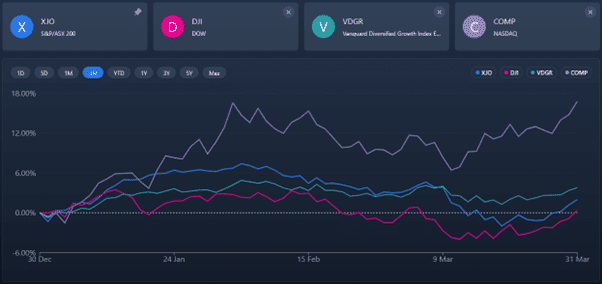
In the first three months we have seen one of the best starts to the year across the globe with investment markets. In Australia the ASX grew by nearly 8% by Feb 2nd and the NASDAQ grew by about 17%.

By mid-March, a lot of those gains were wiped away and the biggest US stock exchange was in negative territory. This is very much on the back of global fears that the continued rising rates were leading to a recession and when SVB collapsed due to a “bank run”, global fears turned to a banking crisis and it seemed that investors were having PTSD flash backs to the Global Financial Crisis (08/09).

The fears of a global financial crisis seemed to be averted and with softer language from federal banks around the world which indicates an easing of rate rises, investment markets have released a sigh of relief.

Australian Outlook:

The outlook for Australia is mixed in my opinion. The Australian economy faces some serious problems but we may be in an excellent position to deal with them comparatively to other countries.

The biggest issues facing Australia right now are:

  • Increased cost of living
  • Massive increases to debt funding
  • Housing shortage
  • Skills and labour shortages
  • Security fears and sanctions on Russia

When in isolation these issues can be dealt with in a manageable way. The major problem is that all of these chickens (along with quite a few others) and coming home to roost all at once.

The typical process of governments and reserve banks of spending their way out of recession is looking unlikely as we have major skills shortages and government debt has already been run up quite a lot. Couple that with a high cost of goods due to sanctions and supply chain issues and we are one credit crunch away from having a very hard landing.

This means that it is imperative that the reserve bank plays a very fine line between reducing inflation and destroying credit availability.

On the flip side, globally, we are on the brink of a technological revolution with AI leading a lot of advancement. This will be underpinned by raw materials which Australia has a long history of using to its advantage.

International outlook:

The global outlook remains similar to last quarter. The major difference comes down to two things:

  1. Credit
  2. Security

Global credit is being challenged through high interest rates and when the US Fed moves the interest rate up, generally smaller economies follow suit in order to have their bonds remain attractive to investment. Banks across the globe generally do not have as much liquidity as Australian banks and regional banks (whilst still massive) need to undertake riskier investments to attract deposit holders.

We saw the spectacular collapse of SVB and then Credit Suisse and it is my belief that we are going to see a lot more of these kinds of collapses over the coming months. This is because in tough times, good companies prosper and poorly managed, overleveraged and/or unprofitable companies fall over. This is as much of a fact in the investment world as the sun setting and rising.

Security is the other factor that is causing pain and it doesn’t look likely to end. China and Russia are actively building the systems to stop using the US dollar as the globes reserve currency.

This is and should be frightening. A major change in the balance of power and currency could have catastrophic and unknown consequences. Whilst frightening, don’t be too alarmed about this.

The global positives are that there are incredible advancements in technology that will change the way we work and interact with each other and all reports about energy advancement seems extremely promising as well.

What does all of this mean for you?

We expect another challenging year in investments as everyone finds their feet. In times like these, there are a lot of opportunities available. The key determining factor in success in 2023 will be cashflow and disposable income that can be used to take advantage of market volatility.


Are Interest Rates Going Up?

kristopher · Apr 11, 2023 ·

Are interest rates going up? In this article you will find out how interest rates work and why they might keep going up or what it would take for them to come back down again.

There is no doubt about it. This raising of interest rates has come at blinding speed which no-one was quite ready for.

Why are they going up?

One reason why the reserve bank is raising rates is to reduce the cost of living (inflation) from continuing to rise at such high levels.

It is crucial to a healthy economy to keep inflation at manageable levels. Which for Australia, is around 3%. Currently inflation is at 7%.

How does raising rates reduce inflation?

As the only tool in the reserve banks arsenal, raising interest rates reduces inflation by two factors:

  1. Increased rates mean money is harder to borrow. This takes the heat out of the ability for you to use debt to expand your business or pay more for assets.
  2. Increased rates means disposable income is lower. If your loan just went from costing $20,000 to $50,000 then you just lost that ability to spend or save $30,000. This also reduces the demand in the market for goods and services.

When will rates stop rising?

Rates will get getting higher if inflation stays high. There has been only a small effect on inflation with the recent rate rises. This has forced the RBA to keep raising them. The RBA will likely stop when either:

  1. They break something. (a lot of people are saying that has already happened in the banking sector recently)
  2. They see a material effect on inflation. This is trickier because a lot of our inflation is caused by a shortage of goods (like petrol) across the globe.

When will rates come down again?

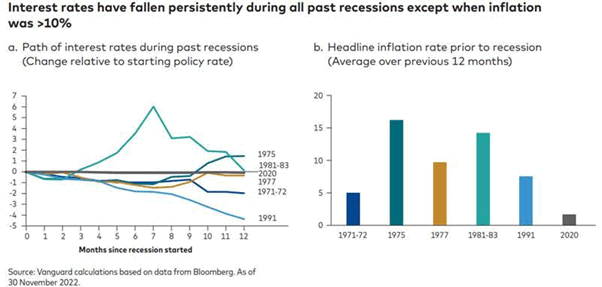
We will probably see rates fall when the economy starts to contract and people stop spending. Look at the graph below. We have seen rates fall every time that there is a recession and inflation is below 10%.


What should you do?

If you are stressed about your interest rate, it is important to know your options.

  1. You can bury your head in the sand. I don’t recommend this.
  2. Be proactive with your rate and borrowed amounts. In tough conditions is where there are the most opportunities. Check your rate is competitive. At the time if writing, 5% is a competitive rate. Also, check that your going to be ok if interest rates keep getting higher. Knowledge is power and if you find out that you are over extended then you can do something about it now. If not, then you can rest easy knowing that you are ok.

Let me know if I can help.

I have a few tricks up my sleeve when it comes to debt and assessing if you are over extended or not. If you aren’t sure where to start then reach out by booking a time HERE. We can discuss your situation and what needs to be done to safeguard and then take advantage of current market condition.

If you haven’t already, you can also read our article on the value financial adviser add HERE or download our helpful guide.


Pay off the mortgage early or invest? Which is better?

kristopher · Mar 22, 2023 ·

Pay off the mortgage early or invest? Which is better?

Should I pay off the mortgage early or invest and save for retirement? This is one of the most asked questions I get as a financial advisor. Accordingly, it’s also one of the most relevant and crucial questions that need to be answered for each person. The good news for you is that there is a definitive answer depending on what stage of life you’re in.

Paying off the mortgage

We all love seeing the amount of money that we owe to a bank reduce. Being debt free is possibly the number one criteria for someone being able to call themselves financially free.

What are the benefits?

  1. In a high interest environment (like we currently have) you’re saving around 5-6%. That means you have effectively guaranteed return on your extra payments of five to 6% (for the average investor that is similar as the 20-year average growth rate.)
  2. There is no tax on money saved. For every dollar of interest earned you get taxed at your marginal tax rate. When you make extra payments, whatever you saving on the interest rate is not taxed.
  3. You gain more equity. How do you pay off more of your home loan? You get more access to the equity within the home. If you have a redraw or offset account you may be able to pull that money out pretty quickly as cash.

You don’t get access to growth.

Investments can provide something that paying off your loan never can. Compounding growth.

There are two major benefits that you can take advantage of when you invest.

  1. Finding the best assets. average rates of return usually reflects the environment and markets at the time. in high interest rate environments where your return on cash is high there needs to be extra incentive for people to invest their money into things like property and stocks. Otherwise, why take the risk, right?
  2. Future opportunities. Paying of your debt usually doesn’t result in being able to create long term passive income. Having the right kind of investments that have compounding growth and the ability to create income is unique to things like stocks and property (and their variations)

What should you do?

This is an easy question for most of my clients and the people I work with.

If you are under the age of 55 and you aren’t both paying off your debt and setting aside some money to invest, then you’re absolutely insane.

However, if you’re over the age of 55, what you should be doing becomes a question of how you want to retire. Most people will retire at around 65 to 67 years old. Retiring with debt and no income to pay it off will set an awful tone the beginning of your quieter years.

Where this general advice differs is if there are benefits you can undertake that have extra advantages over and above the average investment rate of return. Such as borrowing extra money to invest, investing using your super and getting incredible tax benefits (see our article on saving tax HERE) and investing in high growth strategies that are likely to outpace the average investment return over time.

What you need to know before you act

Whether you decide to pay off your loan early or you decide to invest, you need to be aware that there may be dire consequences of doing either action that may not come to fruition until years later.

So don’t be silly… don’t put all your eggs in one basket. Spread your money around and get good advice.

So, book a time for a 20 minute chat by clicking the link here so we can work out what is best for you.

Follow us on our socials for more content like this.

Instagram – https://www.instagram.com/wealtheon.financial.services/

Facebook – https://www.facebook.com/Wealtheon/

  • « Go to Previous Page
  • Page 1
  • Interim pages omitted …
  • Page 4
  • Page 5
  • Page 6
  • Page 7
  • Page 8
  • Interim pages omitted …
  • Page 12
  • Go to Next Page »
  • Important – FSG & Privacy Policy

K G Meuwissen Nominees Pty Ltd, trading as Wealtheon
ABN 52 159 563 541
Corporate Authorised Representative No. 1277316
Sunraysia Hwy
Redbank, VIC, 3477

Lifespan Financial Planning Pty Ltd
ABN 23065921735
AFSL 229892
Suite 4, Level 24, 1 Market Street
Sydney, NSW, 2000

Information on this site may be regarded as general advice. That is, your personal objectives, needs or financial situations were not taken into account when preparing this information. Accordingly, you should consider the appropriateness of any general advice we have given you, having regard to your own objectives, financial situation and needs before acting on it. Where the information relates to a particular financial product, you should obtain and consider the relevant product disclosure statement before making any decision to purchase that financial product.

This website uses cookies to improve your experience. We'll assume you're ok with this, but you can opt-out if you wish. Cookie settingsAccept
Privacy & Cookies Policy

Privacy Overview

This website uses cookies to improve your experience while you navigate through the website. Out of these cookies, the cookies that are categorized as necessary are stored on your browser as they are as essential for the working of basic functionalities of the website. We also use third-party cookies that help us analyze and understand how you use this website. These cookies will be stored in your browser only with your consent. You also have the option to opt-out of these cookies. But opting out of some of these cookies may have an effect on your browsing experience.
Necessary
Always Enabled
Necessary cookies are absolutely essential for the website to function properly. This category only includes cookies that ensures basic functionalities and security features of the website. These cookies do not store any personal information.
SAVE & ACCEPT