
• Skip to primary navigation
  • Skip to main content
wealtheon-logo-green-white
Book a call
1800 577 336
×
  • How we can Help
  • Team
  • Frequently Asked Questions
  • What we do
    • Save more money
    • Control your debt
    • Pay less tax
    • Grow your super
    • Buy more property
    • Get more investments
    • Create a financial safety net
    • Protect your legacy
  • Blog
  • Important information
  • Contact

kristopher

Quarterly Compass: The End To Low Volatility.

kristopher · Jul 26, 2023 ·

Quarterly Compass: The End To Low Volatility

In the last 3 months a lot has happened. Our June Compass is always an interesting one because we get an opportunity to review the last financial year as a whole and the last financial year was a doozy, both good and bad.

Things at here at Wealtheon have been going well and Lauren and I are being kept busy working on investments and we are growing strongly.

Over at Huxter Estate, our harvest was disappointing, a lot of early rain meant we lost a huge amount of potential grapes. We only got 1t of grapes which is only a quarter of what we yielded last year. Whilst disappointing, we are resetting for this next growing season which means, it’s time to prune. Pruning is one of my favourite jobs but it means freezing our toes off in the vineyard from sunrise until 9am each morning and then again on weekends.

That’s all from us personally, I hope you have also had a ripper 3 months. Without further ado, let’s get stuck in.

What’s Happening In The Economy?

This is the big burning question on everyone’s lips. The only thing that I can say with certainty is that volatility is back in town and it is likely to stay. To clarify, in the years after the Global Financial Crisis, developed nations have seen an extended period of some of the lowest fluctuations in economic conditions in the last 120 years. This has meant that business, property and employment conditions have been some of the easiest during that period of time. This was supported by large amounts of government quantitative easing and low interest rates which has ended.

Further to this the reserve bank sees global growth forecasts to remain low for the next two years sighting inflation and monetary policy tightening. I believe that the economic conditions will remain tough over the next 6 – 12 months whilst people find their feet in a higher interest rate environment.

We are seeing a lot of builders going bust and we are seeing a lot more businesses entering into liquidation and administration and whilst we haven’t had the official numbers in yet, I think we the way people are spending and the general sentiment, it certainly feels like we are in recession.

The good news is that I think that we have avoided the worst case scenario and whilst, I empathise deeply with the people doing it tough right now, I think the recovery will be solid.

Australian Outlook:

The ASX has felt little of the pain that most households have been feeling over both the last 3 month and the last 12 months. With the ASX performing at just under 15% for the year which brings most portfolios back to where they were after a weak year previous. Australian companies have used inflation data to increase pricing across the board whilst also reducing their staff and limiting wages growth which has meant really strong earnings and dividends but it is only adding to the household pain that most of middle and lower income Australia is feeling.

The Aus property market is holding out well in really tough conditions which is a testament to the kind of asset but also has some hair raising red flags. Australian property is some of the most expensive in the world and yet through all of these interest rate rises, has only dropped around 3-4% across the country over the last 12 months. This is mainly due to supply problems. Put simply, there is not enough housing and Australians are being forced to pay more in high interest rate conditions just to get a roof over their head.

Overall, as the title of this compass suggests, My call over the next quarter (and also the next year) is to see some solid returns but large fluctuations.

International outlook:

It looks likely that a recession will rock a lot of the developed economies around the world over the next 12 months but it is important to note that recession does not mean that investment opportunities are gone. International markets remain a very attractive space to hold funds. Most global markets have grown by high single or double digits over the last 12 month. One of the standouts is the NASDAQ which has posted a solid 24% in the 12 months prior to writing this.

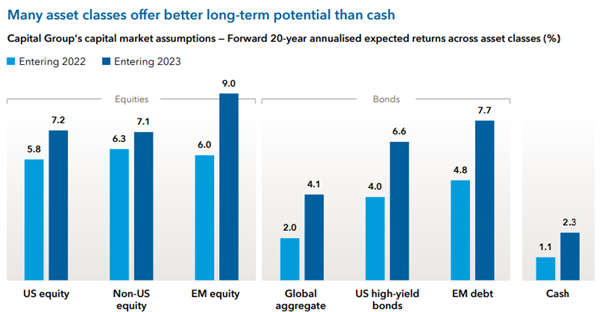
As the graph below shows, expectations on returns across the board are expected to be much greater than cash. It is important to note that during tough economic times, cash can be a safe option but a rush to cash can mean missing out on growth and opportunity.
What does all of this mean for you?

Simply put, we are going to see a lot tougher conditions at a household level in the near future but optimistically, we will likely see so great investment returns and solid results in the near future.

For a lot of our clients portfolios, we have been adding to the core investments over the last year and we are now going to be focussing on bolstering out the satellite investments and taking some concentrated positions in shares and funds to drive some out performance.

Sources

  • https://www.rba.gov.au/publications/smp/2023/may/economic-outlook.html
  • https://propertyupdate.com.au/australian-property-market/
  • https://markets.businessinsider.com/indices

What ChatGPT Thinks You Should Do With Your Money – Part 1

kristopher · Jul 21, 2023 ·

What ChatGPT Thinks You Should Do With Your Money – Part 1

AI is all over the news, our news feeds, and our conversations in general. Almost every industry is talking about AI and what it can do for us, so is the finance world any different?

There are millions of different opinions when it comes to how to manage your finances, so why not see what AI has to say?

As a test not only to see how our top tips stack up, but also as a fun way to see how AI works and to see how a robot can try to make personal finance fun, we’ve asked ChatGPT what it thinks are the 10 best personal finance tips for our readers.

The best bit is – it  gets most of the core philosophies spot on. Although it is very light on the details and hasn’t given much in the way of specifics. That being said, you should always seek professional advice before acting on information you read below.

From debt dominoes to “time in the market vs. timing the market”, ChatGPT had some amazingly similar core messages that are renown industry wide to be effective for your personal finances.

Whilst we obviously do not recommend taking financial advice from AI (haven’t replaced us yet anyway), we’ve found it a really interesting and eye-opening experiment, especially as we head into a new age of technology and use of artificial intelligence.

Check out what ChatGPT had to say here:

“Welcome, dear readers, to the whimsical world of personal finance, where numbers, budgets, and savings become friends you can count on. Today, we embark on an adventure guided by none other than ChatGPT, your trusty financial companion. Buckle up and prepare to laugh and learn as we share ten humorous yet accurate personal finance tips to help you navigate the treacherous waters of money management.

  1. Budgeting: The Art of Balancing Wants and Needs. Budgeting doesn’t mean giving up on all life’s pleasures, like that extra scoop of ice cream or the latest gadget that’s calling your name. Instead, think of it as creating a “financial buffet.” Allocate most of your resources to the essentials, and save a portion for the fun stuff. The key is to be flexible, just like your stretchy pants on an all-you-can-eat day!
  2. Save like a Squirrel: Nuts for the Future. Picture yourself as a squirrel preparing for winter. Save those nuts, err, dollars for the rainy days ahead. Create an emergency fund to avoid running up a tree when unexpected expenses strike. Remember, acorns today can prevent you from feeling “nutty” tomorrow!
  3. Debt Management: A Strategic Game of Whack-a-Mole. Dealing with debt can feel like a never-ending game of Whack-a-Mole. Attack one debt at a time, starting with the peskiest one, while paying the minimum on others. Once you’ve dealt with one, move on to the next. Before you know it, you’ll be a whiz at knocking those debts right out of sight!
  4. Investing: The Money Rollercoaster. Investing can be a thrilling ride full of ups and downs, much like a rollercoaster. Buckle up and stay on the ride for the long haul, even when the markets toss you around like a popcorn kernel in a microwave. Remember, it’s not about timing the market; it’s about time in the market!
  5. Risk: The Art of Walking on a Tightrope. Life is full of risks, but avoiding them altogether is like trying to cross a tightrope without taking a step. Embrace smart risks, like investing in diverse assets, but always ensure you have a safety net (a financial trampoline, if you will) to catch you if you stumble.”

Tune in for part 2 of What ChatGPT Thinks You Should Do With Your Money soon!

If you’ve had a laugh about this but want to chat about it further, or any aspect of your finances, you can get in touch with us or book a free 20 Minute Discovery Call here. 


Reserve Bank Out Of Order?

kristopher · Jun 21, 2023 ·

Reserve Bank Out of Order?

What It Means for Your Interest Rates, Investments, and More | Wealtheon

It looks like the Reserve Bank is taking out a sledge hammer to battle inflation and economic growth, but unfortunately it’s hitting us all in the pocket. The recent increase in cash rates has been hard on businesses as well as households who are already struggling with the cost of living.

Why is it that every time we hear about inflation either holding steady or having the slightest increase, the .25% interest rate battle axe comes out swinging but when we hear about builders and other businesses going bust, it is still full steam ahead.

So is the Reserve Bank out of order?

The Reserve Bank might have the best of intentions but it’s clear that their strategy lacks a balanced approach. With investments affected by cash rates, households are feeling the pinch even more and in some cases, this can be devastating.

It’s time for the Reserve Bank to work with government to look at ways of controlling inflation without constantly raising interest rates. We need a better balance between economic growth and cost of living that takes into consideration all Australians. Unfortunately, I don’t think any reasonable action on this front will be taken. The political risk is too high right now for governments to meddle in this space.

The question is, how far is the RBA willing to go and what are they going to break in the quest to reduce inflation?

Investing or saving money is becoming increasingly difficult due to these changes – even if we look forward and try to think that these decisions are being made for our own best interests, they’re not making life easier! Not only do higher cash rates make borrowing more expensive but they can also have an effect on returns from savings accounts and investments such as stocks, shares and property.

High interest rates can reduce the bottom line for businesses and increase costs but what we are seeing at the moment is some businesses taking full advantage of the headlines and banking higher profit margins. An ABC article recently shone the spotlight into Coles and Woolworths who raised prices by 10.5% and 8.7% respectively…

So it looks like the Reserve Bank is intent on continuing to wield its sledge hammer in an attempt to control inflation and economic growth. But meanwhile, ordinary Australians are having to bear the brunt – struggling with day-to-day living costs and a shrinking ability to invest or save their hard earned money.

What can you do?

If you’re concerned about how rising interest rates could affect your finances, then you are probably feeling what most people are feeling right now. A lot of people I have spoken with feel like the game is rigged and there is no way for them to get ahead in an environment where there are low wages growth and high cost of living.

It’s time to take control of your financial situation and make sure that you are not affected by any further increases. This could mean looking into alternative investments, or simply being smarter with your budgeting so that you are able to handle any further rate rises. It could even mean the need to reduce your current debt arrangements by selling assets. No matter what option you choose, it’s important to have a plan in place and understand the decisions you’re making around your finances.

If you want to know more, you can check out our other blogs such as this one on negative gearing or are ready to take a step towards getting some professional financial help, you can book a free 20 Minute Discovery Session here.

Source

https://www.abc.net.au/news/2023-05-23/supermarket-prices-increase-coles-woolworths-inflation/102380456


SMSFs vs. Other Funds

kristopher · Jun 14, 2023 ·

SMSFs vs. Other Funds

When it comes to superannuation, there are a variety of options available. But which is right for you? That depends on your individual circumstances and goals. It’s important to understand the differences between industry funds, retail funds and Self Managed Super Funds (SMSFs).

Industry funds are provided by employers or industry organisations and typically offer lower fees, no commissions and tailored financial advice. They can also offer access to additional services such as default death and disability insurance.

However, you have less control over your investments, which could be a downside for some people. Because of the way they are set up and their low cost, industry funds have carved out a large amount of super environment. Industry super often has a lower average balance than the retail and SMSF counterparts. Industry super is usually easy to set up, has no frills and is easy to manage ongoing.

Unfortunately though, when dealing with larger balances Industry super often stack up less favorably because a lot of retail funds and SMSFs have capped fees and are invested differently with can reduce costs dramatically.

Retail funds are usually managed by private providers and may offer more complex investment options than industry funds. Fees can be higher but they often provide access to a wider range of investments such as shares, international assets and property. Furthermore, you have more control over your investments with retail funds compared to an industry fund. The reporting and administration in Retail funds are usually more comprehensive because they are providing a more tailored solution.

The problem with Retail funds is that if the investor does not have the skills or knowledge regarding their investment structures or is not utilising professional advice, the outcomes can begin to deviate over time. Retail funds also capture the self-funded retiree market because of the combination they provide between security and flexibility and being able to craft a bespoke solution for their retirement.

Self Managed Super Funds (SMSFs) give you the most control over your superannuation. But they also carry a range of obligations including compliance, tax and financial reporting that you must be aware of before deciding to go down this route. SMSFs can provide access to the widest range of investments within super but fees can be higher than industry or retail fund options. SMSFs can invest in assets that remain out of reach to Retail and Industry funds, for example:

  • Real property
  • Alternative assets like whiskey, art, cars and gold
  • Leverage through limited recourse borrowing

A lot of recommendations online say that you should have more than $250,000 in super before setting up an SMSF. This kind of blanket recommendation is because of a couple of different reasons.

  1. Cost of setup and ongoing management: The cost of setup is high and ongoing costs are dependent on who is managing the process, however, the costs are often capped which can mean that high balances can be cheaper to administer in an SMSF than in an Industry fund.
  2. Cash flow and diversification of alternative assets: If you have $250,000 in super and want to buy a property then the property is going to represent an enormous % of the balance of the fund which makes the risk factors highly elevated. A higher balance can provide more ability to diversify investments.

Ultimately, only you and your professional advisers can decide which superannuation option is right for your individual circumstances – but by understanding the key differences between industry funds, retail funds and Self Managed Super Funds (SMSFs), you will be better placed to make an informed decision.

So how do you know what kind of super is right for you?

Typically finding the right kind of super for you is going to be determined largely by your balance and your investment needs/preferences.

Consider your level of comfort with investments and the amount of control you want to have over your super. Do some research into each option and seek professional advice before making any decisions. Ultimately, finding the best superannuation option for you will depend on your individual needs and goals.

One of our bread and butter services is helping our clients find the right kind of super for their needs. If you would like some professional support, the first step is to book a 20 minute discovery meeting here.


Sources

  • https://www.investmentmagazine.com.au/2023/02/industry-demographics-highlights-challenges-for-some-funds/#:~:text=The%20average%20super%20fund%20has,a%20balance%20of%20around%20%2490%2C000.
  • https://www.superannuation.asn.au/resources/superannuation-statistics


How To Retire Early

kristopher · May 29, 2023 ·

How to retire early

Are you ready to start living life on your own terms and pursue financial independence? Many people dream of doing just that, but they don’t know where to start. If this sounds like a familiar story, then you’re in the right place!

In this blog post we will explore how millennials and gen X-ers can make their dreams of retiring early a reality. We’ll discuss all the key elements you need to consider when planning for retirement including income sources, investments, and budgeting strategies that will ensure your long-term success.

With some hard work and dedication it can be possible to achieve financial freedom so get ready – let’s begin your journey towards achieving an early retirement!

Assess your current financial situation and determine how much you need to save for retirement

Retirement savings may seem like a distant concern, but it’s never too early to start planning. Assessing your current financial situation and determining how much you need to save for retirement is critical to ensure a comfortable future. It’s essential to evaluate your current expenses, income, assets, and liabilities, as these factors will influence how much you need to save.

Your lifestyle choices and your retirement goals are also important considerations in determining your retirement savings goal. Although this may seem like a daunting task, there are resources and professionals available to guide you in the right direction. With careful planning and discipline, you can achieve financial security and peace of mind in your retirement years.

Make a plan to save and invest wisely

Saving and investing can seem daunting, especially if you’re starting with little knowledge in the field. However, by creating a plan of action, you can set yourself up for financial success. One key step is to determine your financial goals and create a budget to achieve them. From there, consider opening a savings account specifically for emergency funds and set up automatic transfers to ensure consistent contributions.

As for investing, it’s important to research different options such as managed funds, property, stocks, and bonds to find what aligns with your goals and risk tolerance. Remember to also diversify your portfolio to minimise potential risks. By taking the time to make a solid plan, you can lay the foundation for a stable and successful financial future.

Track your spending and create a budget that works for you

Managing your finances can be tough, especially if you’re not keeping track of your spending. But don’t fret! With a little bit of effort and some commitment, you can create a budget that works for your lifestyle. Start by tracking your spending for a week or two. This will give you a good idea of where your money is going and where you can cut back.

Then, set a realistic budget that allows for some indulgence while still helping you save money for the things that matter most. Remember, it’s okay to adjust your budget as needed, but sticking to it will ultimately help you achieve your financial goals. So what are you waiting for? Get started today and take control of your finances!

Cut out unnecessary expenses and find ways to reduce costs

In these tough economic times, keeping a close eye on expenses and finding ways to reduce costs is more important than ever. Whether you’re a business owner looking to trim overhead or an individual trying to live within a budget, it can be a challenge to figure out where to start. Luckily, there are plenty of strategies you can employ to cut out unnecessary expenses and keep more money in your pocket.

From reducing your energy consumption to negotiating better deals with vendors, taking a proactive approach to cost reduction can help you meet your financial goals and weather any economic storm. So why not get started today? By taking a closer look at your expenses and finding new ways to save, you can set yourself up for long-term financial success.

Consider investing in stocks, bonds, mutual funds, or real estate

Investing your money can be a wise decision if done correctly. While there are many options available, stocks, bonds, mutual funds, and real estate are some of the most popular choices. Stocks provide an opportunity to invest in a company and earn returns based on their performance. Bonds are a lower risk option, as you’re essentially loaning money to a company or government entity and receiving a fixed return.

Mutual funds offer diversification by pooling money from multiple investors to invest in various stocks and bonds. Finally, real estate can provide a steady stream of rental income and potential for property appreciation. It’s important to do your research and fully understand the risks and potential rewards before making any investment decisions.

Utilise tax-advantaged Superannuation

Saving for retirement can seem daunting, but utilising tax-advantaged super can make the process much easier. Super offers unique tax benefits that allow your money to grow at a low rate(and eventually tax free), giving you more bang for your buck in the long run. By taking advantage of these accounts, you can set yourself up for a comfortable retirement and enjoy the peace of mind that comes with financial security.

Final Word – How to retire early

In conclusion, if you want to know how to retire early and have a steady income for the rest of your life, start planning and investing now. Assessing your current financial situation will give you a clear idea of how much you need to save. Then, come up with a plan and make sure that you are tracking your spending and creating a budget that works for your lifestyle.

You can also reduce costs by cutting out unnecessary expenses and take advantage of opportunities such as super or even investing in stocks, bonds, managed funds or real estate. Retirement is an important milestone but it doesn’t have to be unfeasible. With careful planning, budgeting and strategic investments, anyone can achieve the retirement they desire sooner than expected.

Now is the time to start implementing these strategies so that you too can experience the joy of retiring early with an envy-worthy income!

If you liked this article and want to read more, check out our article on how to save on tax here.

If you want a hand planning for retirement and need to chat to someone, you can book a free discovery call here. 

  • « Go to Previous Page
  • Page 1
  • Interim pages omitted …
  • Page 3
  • Page 4
  • Page 5
  • Page 6
  • Page 7
  • Interim pages omitted …
  • Page 12
  • Go to Next Page »
  • Important – FSG & Privacy Policy

K G Meuwissen Nominees Pty Ltd, trading as Wealtheon
ABN 52 159 563 541
Corporate Authorised Representative No. 1277316
Sunraysia Hwy
Redbank, VIC, 3477

Lifespan Financial Planning Pty Ltd
ABN 23065921735
AFSL 229892
Suite 4, Level 24, 1 Market Street
Sydney, NSW, 2000

Information on this site may be regarded as general advice. That is, your personal objectives, needs or financial situations were not taken into account when preparing this information. Accordingly, you should consider the appropriateness of any general advice we have given you, having regard to your own objectives, financial situation and needs before acting on it. Where the information relates to a particular financial product, you should obtain and consider the relevant product disclosure statement before making any decision to purchase that financial product.

This website uses cookies to improve your experience. We'll assume you're ok with this, but you can opt-out if you wish. Cookie settingsAccept
Privacy & Cookies Policy

Privacy Overview

This website uses cookies to improve your experience while you navigate through the website. Out of these cookies, the cookies that are categorized as necessary are stored on your browser as they are as essential for the working of basic functionalities of the website. We also use third-party cookies that help us analyze and understand how you use this website. These cookies will be stored in your browser only with your consent. You also have the option to opt-out of these cookies. But opting out of some of these cookies may have an effect on your browsing experience.
Necessary
Always Enabled
Necessary cookies are absolutely essential for the website to function properly. This category only includes cookies that ensures basic functionalities and security features of the website. These cookies do not store any personal information.
SAVE & ACCEPT