• Skip to primary navigation
  • Skip to main content
wealtheon-logo-green-white
Book a call
1800 577 336
×
  • How we can Help
  • Team
  • Frequently Asked Questions
  • What we do
    • Save more money
    • Control your debt
    • Pay less tax
    • Grow your super
    • Buy more property
    • Get more investments
    • Create a financial safety net
    • Protect your legacy
  • Blog
  • Important information
  • Contact

kristopher

Is Financial Advice worth it?

kristopher · Mar 10, 2023 ·

Is Financial Advice worth it?

If you ask Reddit if financial advice is worth the money spent then you will be inundated with hate mail about financial advisers. As a financial adviser myself, I know what I do for clients but I have been looking for hard data on how much value we really do add to people. You will see all of the anecdotal horror stories about how I am basically the devil.

Finally, I can prove to the keyboard warriors that my life isn’t a worthless waste of time.

Who has come to rescue my self worth? Funnily enough, there are actually two juggernaut investment managers who have looked at this area for the last couple of decades. Vanguard and Russell Investments.

Most recently (2022) Russell Investments calculated the value of a Financial Adviser. This cost was calculated to be at least an extra 5.8% per year. Most advice costs are between 1 and 2% each year which means the value added is around 3-6 times the cost.

This report really confirms what I know already… The reality is that financial advice is worth it for people who don’t have the skills, time or diligence to figure out how to navigate and utilise our very complex financial, tax and legal system to their best advantage.

Most of the people we work with know that there is a better way that they can run their finances than they can achieve themselves.

Here are a couple of highlights from the report, it was calculated and value categorised under 5 different parts with three of those with definable value adds:

  1. Appropriate asset allocation – Extra 1.6%
  2. Behavioural coaching – Extra 2.9%
  3. Choices and trade-offs – Variable benefits
  4. Expertise technical and emotional – Undefinable but considered priceless
  5. Tech savvy planning and investing – Extra 1.3%

This report is only taking into consideration benefits on a lump sum of money. Russel equated it to being $5,800 per $100,000 invested.

If I factor in strategies like our debt domino, automated savings system, parachute plan and passive income pathway. I am pretty confident we can blow even those numbers out of the water.

If you are wondering if financial advice is right for you, and you want to chat with one that can show you the value add before you make any major decisions. Then you need to click the link here and book in for a 15 minute phone call directly with me.

P.S Don’t get me wrong, I get that some people have had some bad experiences with advisers. I am not saying that there hasn’t been some bad eggs. That isn’t the norm anymore and most of those buggers aren’t advisers now. We threw them out 😉

Also, don’t think I have pulled this info from nowhere. I am not going to regurgitate the 14 page report. You can download it here: https://russellinvestments.com/au/financial-advisers/your-business/business-solutions/value-of-an-adviser#ColorBoxesRoot_9c51613d-d25f-489a-a265-9c08ea63e60b

If you liked this article and want more content from us, check out our tax savings through super blog here.

Disability Support Pension Problems – A Case Study

kristopher · Mar 10, 2023 ·

Disability Support Pension Problems – A Case Study

If your client receives a personal injury compensation payment of around $500,000 after a workplace accident, it may affect their eligibility for a disability support pension.

Read on to find out how disability support pensions can impact compensation.

When a court awards a lump sum for damages, or your client settles on damages, this lump sum can result in a preclusion period. During this time, your client will not be eligible for income support payments like the disability support pension. If your client has previously received a Centrelink benefit during this preclusion period, they may need to repay the benefit received. However, your client may still be able to access the Health Care Card or Commonwealth Seniors Health Card during this time.

The length of the preclusion period will vary depending on whether the compensation amount related to economic loss can be identified. For example, if a compensation claim is contested through a court, tribunal, or arbitrator, the specific amount awarded for economic loss will be identified. This economic loss includes lost wages, lost capacity to earn, and lost superannuation contributions. On the other hand, an agreed lump sum through settlement will not typically identify how much relates to economic loss.

If the amount awarded for economic loss is known, the formula for calculating the preclusion period is:

Preclusion period = Amount awarded for economic loss / single income test cut off amount

The income cut-out amount is the amount above which no pension is payable to a single person under the ordinary income test. The single fortnightly income test cut-out amount is $2,243, and the weekly amount is $1,121.50 as of 1 January 2023. The preclusion period is the result of this formula, which is then rounded down to the nearest whole week. The income cut-out amount that applies is the figure that applied at the time the lump sum is received.

For example, if a court judgment specified that $200,000 be paid for pain and suffering and $300,000 for loss of earnings, the preclusion period is 267 weeks, or just over five years. This means the client will not be eligible for benefits such as JobSeeker, Disability Support Pension, or Age Pension until after this preclusion period is over.

If the compensation is via settlement and the economic loss amount is not specified, the 50% rule would apply. Under this rule, it is assumed that half the compensation payment relates to economic loss.

Preclusion period = Settlement amount / single income test cut off amount x 50%

For example, if a client accepts a settlement payment of $500,000 for injuries, $250,000 will be treated as compensation for economic loss. In this instance, the preclusion period will be 222 weeks, or just under four and a half years.

Centrelink’s compensation estimator can help to calculate the preclusion period for compensation settlement payments. For more information, please refer to the Income Test Info and Social Security Guide here. 

Simple deduction to save on tax

kristopher · Feb 17, 2023 ·

There is a tax rule that every Australian needs to be more familiar with that can save everyone over the age of 18 a heap of money every year and can wipe off a heap of capital gains.

Extra Super contributions.

Why is it beneficial?

Super is only taxed at 15% so anyone making more than $45,000 is paying at least twice as much money in tax than they would by making some extra contribution. Better yet, when you turn 65 there is NO TAX on income or capital gains.

There are not many places you can put your money and end up paying no tax… at least not legally…

The savings are so good that the government has put a limit on how much you can claim each year which is only around $27,000 total (that includes how much your employer puts in).

If you put in extra money your contributions can then be invested which can make you even more money all whilst still being taxed at an ultra low rate.

You can save big

Consider this, if you earn between $120,000 and $180,000 p/a and make a $5,000 deductable contribution, you will save $1,875 on tax. If you make the extra maximum deduction you could save over $5,000.

Even of a lower income the savings are big. If you earn between $45,000 and $120,000, you will save $1,750 on tax for every $5,000.

The savings are even better in the highest tax bracket…

You even have the ability to use previous years contribution limits if you have less than $500,000 in Super. This makes it a perfect way to reduce your capital gains bill.

Business owners have a whole other set of opportunities available to them as well when they sell their business. Those benefits can add hundreds of thousands of dollars in value. Reach out if you want to know more specifics.

What you should do about it

It’s not all sunshine and rainbows though. There are rules on how much you can put in, when you can take it out. You need to be confident that your super is the right one to add extra money into. Avoid some of the pitfalls by reading our retirement income article.

You can find out more info on the ATO website as well as our pay less tax page. But if you want to have someone tell you how you can take full advantage of this incredible and legal tax saving strategy, click the link below and we can chat for 15 minutes at no cost with me directly and see how this stacks up for you.

Let’s Chat!

Quarterly Compass – January 2023

kristopher · Feb 1, 2023 ·

Welcome to the New Year and the January quarter!

Lauren and I hope you have had an excellent festive break and you are taking full advantage of all of this hot weather.

We have some exciting things that we are working on this year at Wealtheon which I am really excited to be developing. We are creating some new concepts that we will be rolling out in the new financial year so stay tuned for some announcements on that.

Let’s get cracking into the Quarterly update and as always, if you have any questions or need any help, please reach out.

Market Update:

The last three months have been a rollercoaster in investment markets which is indicative of how things were over the last year. I was watching markets dip just before (and over) Christmas and then rally just after the new year. In Australian markets ( which has been one of the most resilient over the last 12 months) We saw drops and increases of more than 5% four times. After suffering the worst year since the GFC, there are a lot of markets that have not faired as well as the ASX or DJIA.

Even a lot of season pros have had the jitters in 2022 as it is being nearly 200 years (the early 1800’s just after the American and French revolutions) Since U.S. stocks and bonds fell by more than 10% at the same time.

We are expecting more of the same roller coaster in 2023 as everyone from individual investors or national economies try to manage the unexpected inflation (and if there is anything that markets hate, it’s uncertainty) but with we think that markets will settle down this year and resume some good growth and strong dividends.

So what do we expect to see?

Australian Outlook:

It feels like a reset of 2022 in Australia which whilst still feeling the after effects of the pandemic has bounced back relatively well. In 2020 and 2021 we were supported by a lot of government spending and low interest rates but all of that has lead to a situation where the chance of a recession is likely.

Australia faces a housing dilemma which is fast becoming a crisis as people struggle to find rentals at homes or funding new builds. this is happening at the same time as the increase in interest rates have brought values screaming back to where they were a few years ago.

As far as advanced economies go Australia should be able to weather the storm relatively well because of our strong commodity exports the opening up of China and improving relations with the second biggest economy in the world as well as the strong labour market.

I think our biggest strength is the fact that our labour market is so tight whilst we have such low unemployment it’s quite difficult to really feel the effects of a recession for the average person.

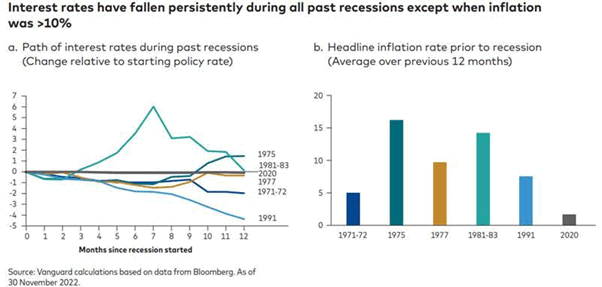
if we look at prior evidence we may expect a rate cut if there is a recession it is my belief that inflation spiking and the run of interest rates to its current levels has been part of a strategic decision to be able to soften a fall if there is a recession by reducing rates again. prior evidence is showing that interest rates have dropped during recessions except where inflation and cost of living has been greater than a 10% annual basis

International Outlook:

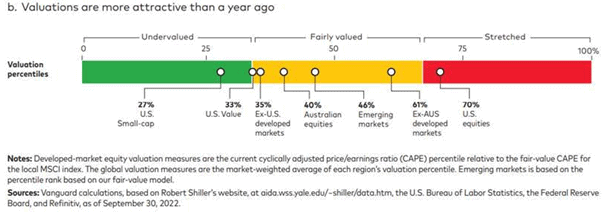
The correction in international markets have led to some better valuations but we still saying quite a lot of meat in the bone within the technology sector in the US market global stocks ah likely going to perform on par with bonds over the next 12 months in most developed nations as many developed international shares are fairly valued or still in some instances overvalued. international small cap investments got hit some of the hardest last year and his my belief that they will be some of the biggest winners over the next few years as they are able to take advantage of a nimble market.

Rates on bonds have grown past dividend you rates which is great for the average retiree investor it does mean that companies will have less opportunities to borrow money and leverage for growth as credit becomes harder to service the value stack on mergers acquisitions and development costs will crunch businesses that don’t have extremely good growth prospects.

What’s going to happen?

I’m expecting people to find the new normal in 2023 and there are some massive advantages that will likely lead to some decent investment returns. bonds for the first time in about four years I looking more attractive as we have to get more money from the yield. we are also in the era of incredible technological advances it is my belief that technology will provide a lot of relief To modern problems in an increasingly globalised world.

I’m personally hoping that a recession will call for some removal of red tape struggling industries like agriculture and construction But I’m not gonna hold my breath waiting for that to happen.

What does all of this mean for you?

all markets rise and fall and this last 12 months has been a great example of that. now moving ever diversified approach to investing and markets in general he’s going to hold the most amount of value over the next five years. this also means that there will likely be some opportunities as we review your situation over the year in order to take advantage of particular stocks and companies that of riding the roller coaster I will provide some incredible discounts that we can take full advantage of.

What should you do about it?

In an inflationary environment like what we have one of the best things you can do is demand high wages and take advantage of the labour market right now. now is also an imperative time to be investing money and not having it sit around in a cash account. the reason for that is that whilst growth prospects may be uncertain with inflation at 7% there is a guaranteed loss on money just sitting in a bank doing nothing.


As always, if you have any questions or would like to discuss any of the above or your portfolio further, please reach out to us on 1800 577 336, or via email at hello@wealtheon.com.au. Speak soon!

Quarterly Compass – What’s happening in global markets and what it means for you.

kristopher · Oct 7, 2022 ·

Welcome to the quarterly update email for September.

2022 has been a crazy year so far. In the last three months of this year it’s important to reflect on some of the things that have happened and where things are heading. Most the world is still reeling from the effects of a global pandemic which has changed the way that we interact with each other and how we work. There is a war in Ukraine which escalated in February and this has caused massive energy insecurity and inflation largely due to Russian sanctions.

Whilst there is a lot of doom, gloom and uncertainty with things out of our control, it’s important to note that nothing is ever as good or as bad as it seems. Whilst we cannot predict what will happen or stop it from getting worse, we are in full control of the actions we take to prepare for, ride out, and recover from the storm.

It’s very important to remember that whilst the short-term outlook may be bleak, the markets can rally at any time and start to pick up. It could be tomorrow, next week, or a year from now, but if we pull our money out now driven by fear, we may lose much more than if we had stayed the course. Any decision make regarding the investment markets needs to be considered and logical, rather than reactive and born from emotion. Without knowing when the upturn will be (and there always is an upturn!), we cannot make a considered decision to pull out.

With that being said, here’s our breakdown of what is happening in the markets, what it means for you, and what you should be doing about it.

Market Update:
Nearly all global equity markets across the world were sold down in the first half of 2022 as investors and markets have been worried about central banks lifting interest rates to fight what seems to be a crazy amount of inflation. This coincided with the invasion of Ukraine and the Russian military action. As a result, in the first six months the NASDAQ dropped over 30% and the S&P 500 was down over 20%. More emerging markets also took a battering as cost of goods continue to rise globally.

In an attempt to reduce this inflation reserve banks across most of the developed world have lifted rates faster than most people ever expected. This has meant that there’s been no safe haven in the global bond market which normally is a place of security when investment markets are falling.

The concern for markets has been one where the prediction is that high rates would tip and force economies into recession and that there would be limited or negative growth. Many economists have had fears that current market conditions would end up with ‘stagflation’ (no growth with high inflation) and similar results to the economies of the 1970s and 1980s.

There was a small rebound in June with the prediction that slowing US economy will result in a slowdown in the US Federal Reserves rising rates. With continued high inflation, this hasn’t been the US Federal Reserve’s stance and after the rate rise in September, we’ve seen markets fall back to similar levels that they were at in June.


Australian Outlook:
Australian markets saw some resilience in the first half of the year but have since joined global markets, seeing a  reduction of around 15%.  There doesn’t seem to be a safe haven in Australian markets either, as interest rates have risen and we’ve seen property prices start to drop across nearly all capital cities (down around 5.5% nationally from last year’s highs). With inflation sitting at 6% and cash term deposit rates at around 3%, the buying power of money even sitting in cash is dropping substantially. The Australian stock market is at 6400 points which is similar levels to where it was just before the global financial crisis.

With the weakening Australian dollar against the US, we may be in for some more inflationary pressures on imported goods which can mean some more pain at the shops and the fuel pump.

What’s going to happen?
We don’t have a crystal ball, but we can look to history to give us some guidance and what may come in the short term. We’re likely going to see a continued rising of interest rates to bring inflation under control which may cause a recession, however unemployment remains very low which is inconsistent with a recession.

What does all of this mean for you?
In simple terms what all of this means is that the cost of living is going up, how much you’re going to have to pay back to the bank in the form of your interest rates will continue to rise, and this is going to mean that asset prices are going to continue to fall in the short term.

What should you do about it?
In terms of the rising cost of living which includes mortgage rates, now is the right time to reflect where your money is going, what your interest rates are and how much you can save. In times like this your cash flow is extremely important and if you feel as though things are getting too tight, please reach out as there may be a number of things that you can do in order to safeguard your financial position.

In terms of investing, we always expect markets to drop and for times to get tough. What you should do in periods of time like this is to be patient with your investments, hold on to them as best you can and if possible, look for opportunities to take advantage of low asset prices.

Next Steps
In order to share as much information as I can, we have organised an exclusive webinar for you which will run through a deep dive into what’s happening in the markets and what it means for you and your portfolios. I’ll be joined by Vanguard’s Investment Specialist Libby Newman to provide some valuable insight on the current economy and it’s effects. You can register for the webinar here.

  • « Go to Previous Page
  • Page 1
  • Interim pages omitted …
  • Page 5
  • Page 6
  • Page 7
  • Page 8
  • Page 9
  • Interim pages omitted …
  • Page 11
  • Go to Next Page »
  • Important – FSG & Privacy Policy

K G Meuwissen Nominees Pty Ltd, trading as Wealtheon
ABN 52 159 563 541
Corporate Authorised Representative No. 1277316
Sunraysia Hwy
Redbank, VIC, 3477

Lifespan Financial Planning Pty Ltd
ABN 23065921735
AFSL 229892
Suite 4, Level 24, 1 Market Street
Sydney, NSW, 2000

Information on this site may be regarded as general advice. That is, your personal objectives, needs or financial situations were not taken into account when preparing this information. Accordingly, you should consider the appropriateness of any general advice we have given you, having regard to your own objectives, financial situation and needs before acting on it. Where the information relates to a particular financial product, you should obtain and consider the relevant product disclosure statement before making any decision to purchase that financial product.

This website uses cookies to improve your experience. We'll assume you're ok with this, but you can opt-out if you wish. Cookie settingsAccept
Privacy & Cookies Policy

Privacy Overview

This website uses cookies to improve your experience while you navigate through the website. Out of these cookies, the cookies that are categorized as necessary are stored on your browser as they are as essential for the working of basic functionalities of the website. We also use third-party cookies that help us analyze and understand how you use this website. These cookies will be stored in your browser only with your consent. You also have the option to opt-out of these cookies. But opting out of some of these cookies may have an effect on your browsing experience.
Necessary
Always Enabled
Necessary cookies are absolutely essential for the website to function properly. This category only includes cookies that ensures basic functionalities and security features of the website. These cookies do not store any personal information.
SAVE & ACCEPT